|
         |
 |
||||||
 |
His "love" for Pi began in high school. There were these posters of Pi and e carried out to many decimal places just lying around in his math class, so of course he picked them up. Junior year, his Trig teacher offered an automatic "A" grade to anyone who could memorize 6000 digits of e. Unfortunately he only got to 4500 that year. These were, of course, just memory games rather than expressions of love for Pi and e. But they made people associate his name with these numbers, so Pi and e became topics of conversation between Missile and other students. His fascination for Pi actually begin in his literature class senior year. The textbook for the class was the New Yorker magazine. In one issue, he found an article titled something like "The Mountains of Pi." It was mainly about two brothers who had built a parallel computer in their apartment which they used to break the world record for calculating digits of Pi. The article was lovely, going into details of the history and uses of Pi. It inspired the Missile to choose Pi as the topic for his next paper in the class. It was a short paper which required no research on Pi, but it did cause him to think about Pi, how he had used it, how I could use it, and its ubiquity in mathematics and everyday life. The paper was pretty lame, but the thinking what went into it gave him a whole new perspective on Pi. During the summer between sophomore and junior years in college, Miszler read a wonderful book called "A History of Pi" by Petr Beckmann. It relates the history of Pi to the evolution of mathematics and the history of society all over the world. Beckmann was an electrical engineer rather than a mathematician, therefore the book is very non-rigorous and readable for even non-scientists. Your candidate recommends it to everyone! His studies at Lafayette increased his admiration of the number. Pi came up in every branch of math or applied math he studied there: Calculus, Probability, Linear Algebra, Complex Analysis, and Differential Equations. Most surprising and interesting was the presence of Pi in probability. One homework question (which I also saw in Beckmann's book the following summer) was: If you are standing on a floor made of parallel wooden beams and you toss a pin up in the air, what is the probability that it will land on a crack? (Of course the question was more specific than that - you need to know the width of the beams, length of the pin, etc.) The answer has Pi in it, which the Missilenever would have suspected if he hadn't taken the class. A couple years ago (in response to the Pi Recitation Contest on the web), Missile memorized a few more digits of Pi (bringing me up to 5000 digits, about half of which he has since forgotten since). But that's just more memory games. His real love for Pi comes from learning about its importance and ubiquity in the world. |
|
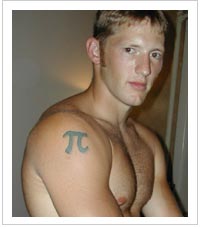 Nope. This isn't a statue somwhere in Athens. This is a rare glimpse of the Missile at his most vulnerable. |
|
||
|
||||||
|
||||||